
29 December 2011

27 December 2011
La Fouly, c'est la folie!

Sortie ski de fond avec Mél et David ce matin.
Cela vaut vraiment la peine d'aller au bout de la vallée tellement le décor sur les pistes de La Fouly est magnifique.
On voulait faire du fond... on avait le coeur dans les amygdales; normal pour une première de la saison!
A la moindre petite bosse tout s'emballe.


C'était magnifique! Vivement demain où nous irons vers un autre lieu.
Et surtout ne pas négliger la récup. après le ski!
BanZaïïï!!
24 December 2011
Le footing du Père Noël
Premières heures valaisannes et premier footing de 30 min pour bien préparer mon corps à ces deux jours festifs.Y'a comme un truc qui ne joue pas! On m'aurait menti?!?!!
23 December 2011
Up up and away!

"What's going on?", I was thinking. "Shouldn't I be building the athlete of the next summer, working on my weaknesses? Am I not making mistakes in trundling along so easily" This is where Alan's guidance is coming in, which helped me change my perspective on how to train and what to change.
 Last year I trained incredibly hard for Ironman France, to the extent that I was struggling to keep work, training, and life balanced and often felt on edge, sleeping badly. What had happened? After a great race in Clearwater in November of 2010, I took a couple of weeks off and jumped right back into training in December. My workload (TSS) was very high in January and February, actually almost as high as in the key months before the Ironman. February was a different story, with a two week trip to friends' weddings in Latin America. In March and April it was back to the menu of big training.
When I look at how I trained, it also becomes visible that I was training at relatively high levels of intensity. TSS per hour tells us the level of intensity, with 100 being at threshold (i.e. a 10km race run at full speed). I was doing my average training at about 65 TSS per hour, showing that I worked a lot in high intensities.
 I have learned since that big athletes like me are much more at risk of burning out and getting injured when training intensively. So what to change?
Alan has really changed two things for me, and it takes time to accept them after a couple years of focusing on going fast and hard and a long period of time where I was pretty fit. The first thing is progressive load. We can see that September was my lowest month since November 2010. This was after Ironman Wales, with recovering from the season. But instead of jumping right back in, the workload is still pretty low and only rising a little each month. October was a bit bigger than November, December will be a big bigger than November, etc, until we get to Frankfurt in July. This means that fitness is much lower at this time of year, but will hopefully be higher when it matters, because I will be less tired and can really put the pedal down when I need to.
The second thing is a reduction in intensity. My fatigue curve and short numbers point to the fact that I am better on short distances than on long ones, so the task is to get my endurance to improve. Hence lower intensity training that helps build endurance, and less focus on building VO2max or threshold. Looking at the second graph, there is a drop in intensity from July/August of this year, when I started working with Alan. I expect to see a lot of endurance work with a bit of sharpening towards the key race (Frankfurt), but overall the training will be a bit slower than before. Patience will be of the order :-).
22 December 2011
Régime des Fêtes
Demain, dernier jour de travail avant d'aller prendre l'air à la montagne... enfin, en bas de la montagne: à Martigny pour une semaine. Je vais y recharger mes batteries clairement branchées sur un panneau solaire. Et le soleil, à Genève, en décembre, ce n'est pas à la mode. Par contre, il se dit qu'en Valais, il fait toujours beau!! Alors j'ai envie de dire: alors tant mieux! Mais tant mieux qu'il fasse toujours beau en Valais!
Au programme, un peu de natation, de la course à pied mais surtout dans la mesure du possible du ski de fond. Le bon plan pour faire mon endurance de base dans la nature en faisant un autre sport. Objectif de cette dernière semaine de 2011: me ressourcer un max pour pouvoir recommencer 2012... doucement!! Car c'est encore long!! :-) Joyeux Noël à tous.
Au programme, un peu de natation, de la course à pied mais surtout dans la mesure du possible du ski de fond. Le bon plan pour faire mon endurance de base dans la nature en faisant un autre sport. Objectif de cette dernière semaine de 2011: me ressourcer un max pour pouvoir recommencer 2012... doucement!! Car c'est encore long!! :-) Joyeux Noël à tous.
19 December 2011
Week 4: Summary (W-29)
Nous voici à la fin de la 29ème semaine d'entrainement avant le duel:
| Swimming | ||
|---|---|---|
| Sessions | 2 | 3 |
| Distance | 6.8km | 6km |
| Time | 2h | 2h00 |
| Biking | ||
| Sessions | - | 2 |
| Distance | - | 90km |
| Time | - | 3h |
| Running | ||
| Sessions | 3 | 5 |
| Distance | 31km | 50km |
| Time | 2h40 | 4h10 |
| Strength | ||
| Sessions | 2 | 2 |
| Time | 3h45 | 1h15min |
| Total | ||
| Sessions | 7 | 12 |
| Time | 8h25 | 10h25 |
| TSS | 480 | 500 |
| Other | 73 kg 1 séance d'acupuncture | 90 kg 1 massage |
| Summary | ||
| Goal for the week | Faire du sport quand je peux | Keep things going during the crazy pre-Christmas period |
| The good | Footing dans la neige samedi | Very nice run in London on Saturday! |
| The bad | Fatigue générale | Seem to be getting slower and slower, but no worry, we are building strength! |
| Thoughts | Travail + Sport + Fêtes de fin d'année = Valises sous les yeux / vivement les Vacances!!! | One week till Teneriffe! |
18 December 2011
En hiver on va tourner rond!
C'est parti pour réapprendre la base: tourner rond, tourner souple, tourner petit! J'suis prêt à faire du une jambe dans mon salon!


15 December 2011
Big or small, in the end the (hopefully) all get there
Alain is all about his training, his secret weapons, and his insights. So he thinks he can rattle me with this little duel?
Little did he know that when I innocently proposed doing Frankfurt Ironman, the race was already over before it began. Well, Alain likes the warmth, and in Frankfurt it is cold:

And of course, the race is flat, and we know flat races are for big guys. La Grande has done his homework. If both are not enough, we can always get creative:

Little did he know that when I innocently proposed doing Frankfurt Ironman, the race was already over before it began. Well, Alain likes the warmth, and in Frankfurt it is cold:
And of course, the race is flat, and we know flat races are for big guys. La Grande has done his homework. If both are not enough, we can always get creative:

This will be so easy, I don't even know why I'm training anymore. Seriously.
13 December 2011
J'ai voulu être un Mini-Greg: mon histoire, mon combat!
Quand j'ai commencé le triathlon, je l'ai fait seul sans structure. Le hasard d'une compétition inter-entreprise de natation a fait que je me suis remis à nager après une dizaine d'a... une quinzaine d'années sans chlore et sans carrelage. Quasiment dans l'enchaînement je me suis inscrit pour mon premier distance olympique. J'en ai bavé, j'ai aimé (tout sauf la natation!) puis quelqu'un m'a amené vers le Triathlon Club de Genève où je suis membre depuis 2009.
Cela parlait boyau/ pas boyau dans les vestiaires, je ne comprenais rien! Aujourd'hui comme tous les triathlètes, je frime avec des mots compliqués, des gadgets (oh oui des gadgets!) et des concepts semblant de prime abord être réservés aux initiés... c'est bon j'suis dedans! Reste plus qu'à avancer :-/ moins facile que les théories!
La natation m'a permis de pouvoir me frotter aux plus rapides du club et ainsi au fil du temps me lier d'amitié avec (je ne donnerai pas de nom, non, non) dirons-nous: Avrel, ancien nageur puis triathlète, certainement aussi écervelé que moi!
Au cours de l'une de nos nombreuses longues sorties, il m'a parlé d'un blog à hurler de rire (tu veux voir? Clique voir!) et d'un athlète qui le faisait pleurer sur des contres-la-montre par équipe et dont je ne pouvais que m'inspirer. Un mec cool qui nage bien, fait fumer n'importe quel bitume à vélo pour ensuite finir tant bien que mal mais plutôt pas mal sa course à pied, le tout affublé d'un long torse! C'était tout trouvé, ce jour là, j'ai décidé que je travaillerai à être un Mini-Greg! J'travaille encore...
12 December 2011
Week 3: Summary (W-30)
Another week, and the work continues. Great weekend weather made for some nice running and biking, but this Monday morning really sucks!
| Swimming | ||
|---|---|---|
| Sessions | 3 | 3 |
| Distance | 10.2km | 6km |
| Time | 3h10 | 2h00 |
| Biking | ||
| Sessions | 2 | 3 |
| Distance | 75km + home trainer | 190km |
| Time | 3h30 | 6h |
| Running | ||
| Sessions | 1 | 4 |
| Distance | 16km | 44km |
| Time | 1h20 | 3h50 |
| Strength | ||
| Sessions | 2 | 2 |
| Time | 3h45 | 1h15min |
| Total | ||
| Sessions | 8 | 12 |
| Time | 11h45 | 13h05 |
| TSS | 650 | 700 |
| Other | 72.8 kg | 90 kg |
| Summary | ||
| Goal for the week | Reprise | Hitting the rhythm again |
| The good | Magnifique ballade à vélo samedi | Good swim test again, 3km neg split in 48:15 |
| The bad | Rien de particulier | Caught the cold |
| Thoughts | l'envie revient gentiment | I hate winter :-( |
10 December 2011
Boncourt 7h20, Genève pareil
J'ai réussi! Samedi matin se lever pour aller nager...
C'est toujours un grand moment! Un tout grand moment!
C'est toujours un grand moment! Un tout grand moment!
09 December 2011
Bike Passion, une longue est belle histoire
Venons-en au dernier partenaire que nous avons en commun dans cette aventure. Le plus vieux de tous, celui qui nous a soutenu depuis quasiment le départ de notre aventure Triathlon : Bike Passion.
Mon histoire avec Bike Passion date de mes débuts en temps qu’habitant de Genève et Plainpalais en particulier. En effet, habitant à une rue, je me suis naturellement dirigé vers Karnik quand j’ai décidé de participer au 76km du Grand Raid le siècle passé, en 1999. Mes ambitions étaient à la hauteur de la dimension de son magasin à l’époque : petites ! Ce contact a été excellent, chaleureux, dévoué et le travail de qualité. Depuis nos routes n'ont cessé de se rapprocher et mes ambitions se sont agrandies au même rythme que le magasin.

Quelques années plus tard au cours d’une discussion passionnée autour de mes nouvelles activités dans ce monde étrange du triathlon, Karnik me propose de courir pour ses couleurs : Bike Passion. Pas questions de performance dans l’élite, juste une envie de soutenir un projet humain dans le sport, mené avec passion pour atteindre un objectif annoncé. L’ancien sportif d’élite qu’est Karnik a été séduit par l’idée d’un projet à long terme qui devait m’emmener alors jusqu’à l’Ironman. Rapidement, Nico alias La Grande habitant aussi à quelques encablures du magasin nous a rejoint dans cette aventure et voici que quelques années après, avec toujours la même passion, Karnik, Nicolas, Gordo, Ken et Olivier nous soutiennent et suivent notre duel amical au gré de nos visites au magasin. Que ce soit pour un conseil, un coup de main ou une solution pour parer au plus pressé, l’équipe de Bike Passion est toujours prête à nous aider et nous soutient hiver comme été ! Nicolas maitre de cérémonie à l’atelier nous a même rejoint dans le triple effort pour partager cette passion tout au le long de l’année. Un grand plaisir que de pouvoir compter sur c’t équipe !
Merci Karnik, Nico, Gordo, Ken et Olivier pour votre soutien ! Merci Bike Passion !
Mon histoire avec Bike Passion date de mes débuts en temps qu’habitant de Genève et Plainpalais en particulier. En effet, habitant à une rue, je me suis naturellement dirigé vers Karnik quand j’ai décidé de participer au 76km du Grand Raid le siècle passé, en 1999. Mes ambitions étaient à la hauteur de la dimension de son magasin à l’époque : petites ! Ce contact a été excellent, chaleureux, dévoué et le travail de qualité. Depuis nos routes n'ont cessé de se rapprocher et mes ambitions se sont agrandies au même rythme que le magasin.

Quelques années plus tard au cours d’une discussion passionnée autour de mes nouvelles activités dans ce monde étrange du triathlon, Karnik me propose de courir pour ses couleurs : Bike Passion. Pas questions de performance dans l’élite, juste une envie de soutenir un projet humain dans le sport, mené avec passion pour atteindre un objectif annoncé. L’ancien sportif d’élite qu’est Karnik a été séduit par l’idée d’un projet à long terme qui devait m’emmener alors jusqu’à l’Ironman. Rapidement, Nico alias La Grande habitant aussi à quelques encablures
 du magasin nous a rejoint dans cette aventure et voici que quelques années après, avec toujours la même passion, Karnik, Nicolas, Gordo, Ken et Olivier nous soutiennent et suivent notre duel amical au gré de nos visites au magasin. Que ce soit pour un conseil, un coup de main ou une solution pour parer au plus pressé, l’équipe de Bike Passion est toujours prête à nous aider et nous soutient hiver comme été ! Nicolas maitre de cérémonie à l’atelier nous a même rejoint dans le triple effort pour partager cette passion tout au le long de l’année. Un grand plaisir que de pouvoir compter sur c’t équipe !
Merci Karnik, Nico, Gordo, Ken et Olivier pour votre soutien ! Merci Bike Passion !
08 December 2011
Ma machine de guerre
Chers amis de la bicyclette, je lève enfin le voile sur une pièce non négligeable du puzzle qui va m'amener à dompter le parcours plat de Francfort!
Les jambes courtes, le cuisseau ferme et large j'ai sans aucun doute trouvé la solution technique en parfaite adéquation avec le profil roulant de cet Ironman. A voir encore si je pars avec une cassette de 11 ou 12 dents. La décision devrait tomber au courant du mois de juin...
Photo
Les jambes courtes, le cuisseau ferme et large j'ai sans aucun doute trouvé la solution technique en parfaite adéquation avec le profil roulant de cet Ironman. A voir encore si je pars avec une cassette de 11 ou 12 dents. La décision devrait tomber au courant du mois de juin...
Photo
The onion

But it keeps you warm, even in -2!
Alain wird sich warm anziehen müssen in Frankfurt ;-)
07 December 2011
What beautiful curves! (2/2)
Last week I started looking at power output over time and what it means for our Ironman quest. I mentioned Alan's post on fatigue curves over at Endurance Corner, which gave me a great perspective of what's important for Ironman racing.
The 5 and 20 minute tests I looked at last time give you a good idea of your aerobic and anaerobic capacity. But does that help you predict performance over a race that lasts about thirty times as long as the test? It turns out that it's only of limited value in doing so. Alan shows some data on the fatigue curve over longer durations: by how much your power output drops when the duration of the race doubles. Elite Ironman athletes have extremely "flat" fatigue curves - their output drops as little as 5% as duration doubles. Very good age group athletes are in the region of 7%.
The 5 and 20 minute tests I looked at last time give you a good idea of your aerobic and anaerobic capacity. But does that help you predict performance over a race that lasts about thirty times as long as the test? It turns out that it's only of limited value in doing so. Alan shows some data on the fatigue curve over longer durations: by how much your power output drops when the duration of the race doubles. Elite Ironman athletes have extremely "flat" fatigue curves - their output drops as little as 5% as duration doubles. Very good age group athletes are in the region of 7%.
06 December 2011
So many ways to swim...
One aspect of the duel is the "fish against anchor" duel. Alain always gets a huge head start on the bike thanks to my less than modest swimming skills. But I am determined to minimize the loss and to reduce the deficit. What was close to 7 minutes (ouch!) shouldon an olympic distance in 2010 without a wetsuit hopefully become more like 5-7 minutes on the Ironman next year. Yeah right. But all hope is not lost, because now I can visualize how real swimming heros swim, thanks to a link from my coach Alan.
Virtual swim shows the techniques of world class swimmers. The first three on the page are what I learned are called "front quadrant" swimmers, i.e. they always have one arm in front of them and almost swim catch up. This is supposed to work well when you are super fast because it makes for a "long vessle." They also manage to keep their elbows super high and "grab" a lot of water with the forearm. Flexible shoulders anybody? The third one is Grant Hackett, who held the 1500m world record for about 10 years, even through the period when every record was smashed because of the high tech swimsuits. All of them have pretty strong kicks though.
The one that looks a bit different is the last one - the 800m female champion, who swims with very straight arms and rotates very little from the hips. Apparently that is supposed to work well in open water and for triathletes who swim slower than "real" swimmers and who don't have the strong kick and glide for front quadrant swimming.
Hm, now I know a lot more swimming styles but still suck at it. Recognition is the first step to improvement? I hope!
Virtual swim shows the techniques of world class swimmers. The first three on the page are what I learned are called "front quadrant" swimmers, i.e. they always have one arm in front of them and almost swim catch up. This is supposed to work well when you are super fast because it makes for a "long vessle." They also manage to keep their elbows super high and "grab" a lot of water with the forearm. Flexible shoulders anybody? The third one is Grant Hackett, who held the 1500m world record for about 10 years, even through the period when every record was smashed because of the high tech swimsuits. All of them have pretty strong kicks though.
The one that looks a bit different is the last one - the 800m female champion, who swims with very straight arms and rotates very little from the hips. Apparently that is supposed to work well in open water and for triathletes who swim slower than "real" swimmers and who don't have the strong kick and glide for front quadrant swimming.
Hm, now I know a lot more swimming styles but still suck at it. Recognition is the first step to improvement? I hope!
05 December 2011
Week 2: summary (W-31)
Here is the second week summary. Not that different.... december effect?!
| Bibi | La Grande | |
| Swimming | ||
|---|---|---|
| Sessions | 1 | 4 |
| Distance | 3.4km | 13.7km |
| Time | 1h15 | 4h00 |
| Biking | ||
| Sessions | 2 | 2 |
| Distance | 80km | 90km |
| Time | 2h55 | 3h |
| Running | ||
| Sessions | 1 | 2 |
| Distance | Accompagnement des enfants à l'Escalade | 15km |
| Time | - | 1h10 |
| Strength | ||
| Sessions | 2 | 1 |
| Time | 3h45 | 15min. |
| Total | ||
| Sessions | 6 | 9 |
| Time | 7h55 | 8h25 |
| Other | 1 physio 73.2 kg | 1 massage 2 journées de ski 90.0 kg |
| Summary | ||
| Goal for the week | Récup | Semaine récup |
| The good | Pris le temps de voir des amis | Bien nagé; Départ 1:40 passe maintenant facilement en petit bac. Idem sur 3.6km non-stop |
| The bad | Rien de particulier | Pas pu poser toutes les séances |
| Thoughts | Pas facile de bien récupérer au mois de décembre ;-)) | Beaucoup nagé, bien fêté!! |
04 December 2011
What beautiful curves! (1/2)
Alan just posted a great piece on fatigue curves (actually two pieces: here is the first article, here a second follow-up article) - the relationship between our performance over short and long durations. I found this very inspiring and decided to look at Alain's and my fatigue curves in search of some answers. But some background first:
02 December 2011
In our corner: Power2Max power meters

Why power?
Knowing how much power you are putting out whilst riding is an awesome tool to make your training more specific and to know what you are doing at all points in time. Many endurance athletes have been training with heart rate in the past to see how hard they were going. But heart rate is only one bit of information about your training: it tells you how much effort you are putting in, but it doesn't tell you what you are getting out of it. On a good day your heart rate might be lower, if you are very tired it might be affected, too. All this makes things complicated.Power adds a really interesting part to the equation: what you are producing for the effort you put in. This helps you understand how your training is progressing, and it helps you pace your training and your races.
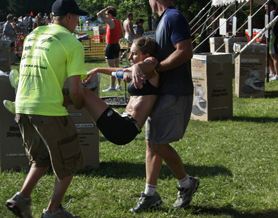 Dan Empfield from Slowtwitch used a great phrase to describe Ironman racing: it's a competition of who can whisper loudest. The race is so long that you can't just go out there and push hard. Otherwise you will go fast for the first few hours, but end up like this way before the finish line:
A power meter can be a great tool to help you figure out how hard to push, especially in the early phases of the race when the legs are fresh, the mind is impatient, and your energy seems infinite - after all you have rested before the big day and are ready to go.
Using the information we collect during training rides and performance tests, we can use the power meter to set power ceilings during the race to avoid going to hard at the wrong time. Expect some more nerdy posts about power analysis in the future!
About Saxonar / Power2Max
Saxonar is a new player on the power meter scene, having released their crank based power meter early 2011. They come from a automotive background, which means they know how to engineer reliable products that work in all sorts of conditions. Both Alain and I used to ride with other power meters - from SRM - and haven't regretted the switch.The Power2Max are just as precise as the much more expensive products from the competition, and they offer convenience that other products don't have: you don't need to put anything else on the bike for it to work (no magnets, etc), and you can change the battery yourself when it eventually runs out - with other products you have to send it in.
Saxonar have also been super quick in rolling out different versions of their power meters, whether for standard cranks, compact cranks, and soon also for mountain bikes. Best of all, they are priced much more reasonably than SRMs or Quarqs, the other two big systems out there.
If you feel the urge to train with power, take a good look at them - their product is great and I'm more than happy to use it.
01 December 2011

Subscribe to:
Posts (Atom)